

Engine valves
Hardness that holds through heat.
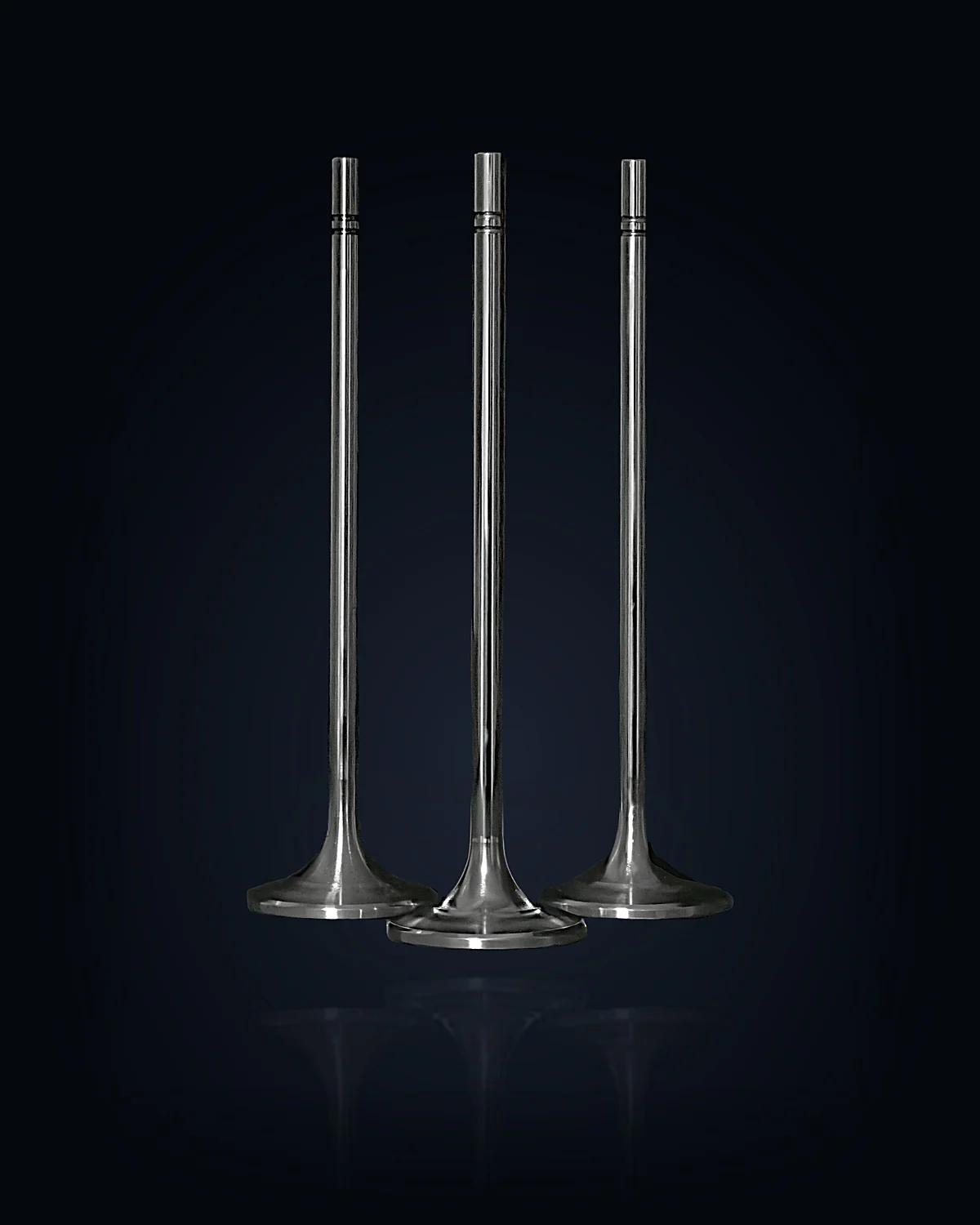
TripleHard® on valve stems: hard-chrome-level hardness as plated, hardness that rises rather than falls after heat cycling to 500 °C, and no measurable attack in hot acid. Made in a Cr(III) hard-chrome process.
- 0 µm
- attack in 5 % H₂SO₄ at 100 °C, 23 min
- 5–10 µm
- coating thickness on the stem
- 500 °C
- heat cycling: harder after it, not softer
Why engine valves
A valve stem lives in heat, acid and motion.
The stem slides in its guide millions of times, at exhaust temperature, in combustion by-products that are acidic. The coating has to stay hard, stay attached and stay thin.
- Heat. Harder, not softer, after heat cycling to 500 °C
- Acid. 0 µm attack in 23 min of 5 % H₂SO₄ at 100 °C; Cr(VI) hard chrome lost 7–22 µm in 2–22 min
- Adhesion. Intact after bend and scratch testing
- Thickness. 5–10 µm on the stem, set from your drawings
How it is produced
On a converted line.
Current TripleHard® has been tested for engine valves. Each customer application is engineered from the customer's drawings and verified during commissioning. The results on this page are from tests on valve stems.
Engine valves are plated on your existing line, converted to TripleHard®: the chemistry, the anodes and their control change, and fume scrubbers are no longer needed. Savroc supplies the process, the chemistry and the support.
Read the technology page How a project works- Changes in a conversion
- Carries over from the existing line
- Carries overHoist and railThe existing hoist carries the part from tank to tank.
- Carries over1 · Surface preparationCleaning, as on the existing line.
- Carries over2 · EtchingActivates the steel surface, as on the existing line.
- Changes3 · Nickel anchor layerA nickel bath is added where the line has none.
- Changes4 · TripleHard® Cr(III) bathReplaces the Cr(VI) bath. Anodes change to graphite or Ti-MMO. Ordinary lip extraction, no scrubber.
- Carries overRinses and rectifierThe rinse after each stage and the rectifier stay as they are.
Technical package
What is measured.
Full test conditions and the regulatory position are on the technology page.
| Acid resistance | 5 % H₂SO₄, 100 °C, 23 min: 0 µm, 0 g mass loss. TripleHard® heat-treated after plating, the Cr(VI) references not, simulating valve service at around 500 °C |
|---|---|
| Thermal behaviour | Hardness increases after heat cycling to 500 °C |
| Adhesion | Bend and scratch test without delamination |
| Hardness | Hard-chrome level, full hardness without heat treatment; the measured range is on the technology page |
| Coating thickness | 5–10 µm on the stem |
Frequently asked questions
Why does the hardness rise after heat cycling to 500 °C?
Heat drives a structural change in the trivalent chromium layer that increases its hardness, where conventional hard chrome softens. The measured result is on the technology page.
What does a plater need to change?
The chemistry and its control: TripleHard® anodes in place of lead, prevention of zinc and copper contamination, and normal ventilation instead of scrubbers. Tanks, rectifiers and handling largely carry over.
How thick is the coating on a valve stem?
Typically 5–10 µm. The exact thickness is set from your drawings for the stem, its guide and its duty, and verified during commissioning.
Ready to start your move off hexavalent chromium?
Send us your drawings and the conditions your parts work in. We simulate the coating on your parts, design the line or the conversion with you and stay through commissioning in your plant.
Start your project with Savroc